
f.a.q.
We are happy to answer your questions regarding BCIs. Is your question not listed here? You can always reach out to us.
A Brain-Computer Interface (BCI) is a system that enables a user to control a computer using brain signals. These brain signals can be measured in different ways: through electrodes on the scalp (non-invasive), on the surface of the brain, or within brain tissue. We use methods in which the electrodes are placed on the surface of the brain during surgery.
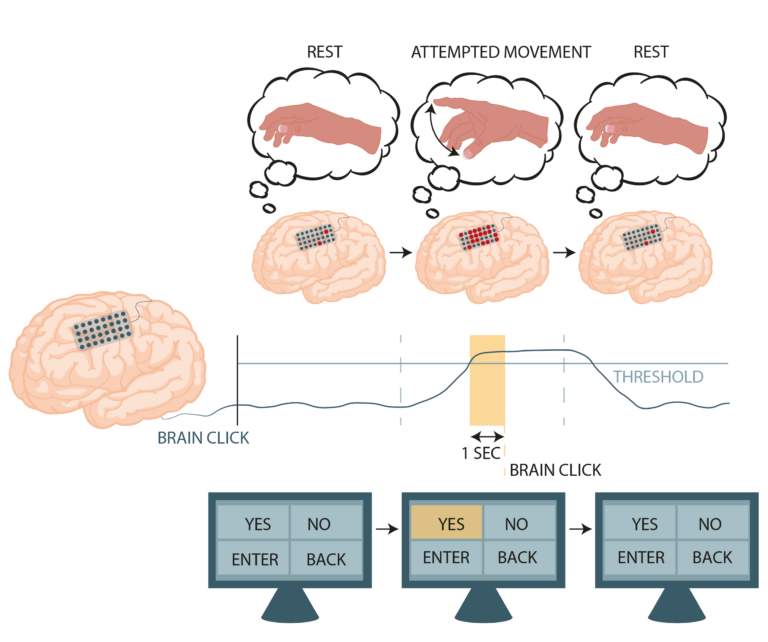
In the figure below, we explain how this works. On the left, you can see an image of the brain with a grid of electrodes placed on its surface. Brain activity changes when a person, for example, thinks about moving their hand or tries to speak certain words. These changes in brain signals are measured by the electrodes and sent to a computer.
The computer is trained to recognize specific patterns in these signals. In the example shown in the figure, the user attempts to move their hand. The resulting change in brain signals is detected by the computer and translated into a mouse click. This is called a brain-click. By thinking about that specific hand movement or attempting to say a particular word at the right moment, a user can, for example, select letters in a spelling program. In this way, people with severe paralysis can communicate or operate a digital device without requiring any muscle movement.
Our research group is currently developing brain-computer interfaces (BCIs) for two different target groups.
First, we focus on people with severe paralysis who have difficulty communicating, or who have a high likelihood of developing these problems within the next two years, for example people with late-stage ALS.
In addition, we conduct research on BCI applications for people with a spinal cord injury who have limited use of their hands and arms.
Finally, we also explore whether and how other patient groups may benefit from the use of a BCI.
Severely paralyzed people with communication difficulties can use a BCI to communicate via a computer. With a BCI, they can type letters or sentences or scroll through a website. In the UMC Utrecht we are investigating how we can best enable this way of communication.
Abroad, research is done on for example controlling a robotic arm using a BCI. There are also studies on in which situations BCIs can be used, for example to stimulate rehabilitation after stroke. A BCI can also be used by healthy people: several companies are working on BCI-based gaming.
To improve BCI technology more research is needed on brain functioning in general, but also on different BCI techniques. Our research group is trying to understand the brain signal patterns when someone is attempting to make a movement or when someone attempts to say certain words. There are also many technological developments that we need to study.
Because BCI is a relatively new technique, we also would like to hear from (potential) BCI users how we can improve BCI techniques. Besides, we are investigating how we can ensure that a BCI will not only work well in the lab, but also at the home of the user.
The development of brain-computer interfaces (BCIs) is advancing rapidly. Universities, hospitals, and companies around the world are working on new technologies to measure brain signals and translate them into communication or device control.
There are several ways to measure brain signals. We use systems in which electrodes are placed on the surface of the brain (ECoG). Other systems use electrodes that are implanted directly into brain tissue. These can be thought of as very small “beds of nails,” with the Utah array being a well-known example. Both approaches have advantages and disadvantages.
Electrodes placed inside the brain can measure highly detailed signals. At the same time, these signals are often less stable over longer periods. As a result, such systems may require regular recalibration, and it is not always clear how well they will continue to function over many months.
Electrodes placed on the surface of the brain may provide less detailed information, but they can measure activity across a larger area of the brain. They also offer an important advantage: they are known for providing stable and reliable signals over longer periods of time. For people who rely on a BCI in their daily lives, this reliability is essential.
Our approach therefore focuses on developing systems that not only perform well, but are also suitable for long-term use in everyday life. It is this combination of ease of use, reliability, and long-term stability that makes our technology distinctive within the rapidly growing field of BCIs.